
The Green project from Kitchens by Holloways

The designer: Emily Pickett at Kitchens by Holloways
Photos Enzo Cerri Photography
Styling JM Interior Design
The story: Kitchens by Holloways are award-winning kitchen, design and construction specialists. They have been designing and manufacturing award-winning handmade kitchens for over 15 years. With a firm belief that a kitchen is so much more than just cabinets, appliances and worktops, the company also love to combine their architectural design skills with kitchen expertise to design a space in its entirety.
Each kitchen is made with pride in their Shropshire workshop by the finest cabinetmakers who combine a passion for traditional craftsmanship with state-of-the-art machinery and technical expertise.
Designer Q&A:
Q) What was your brief from the client?
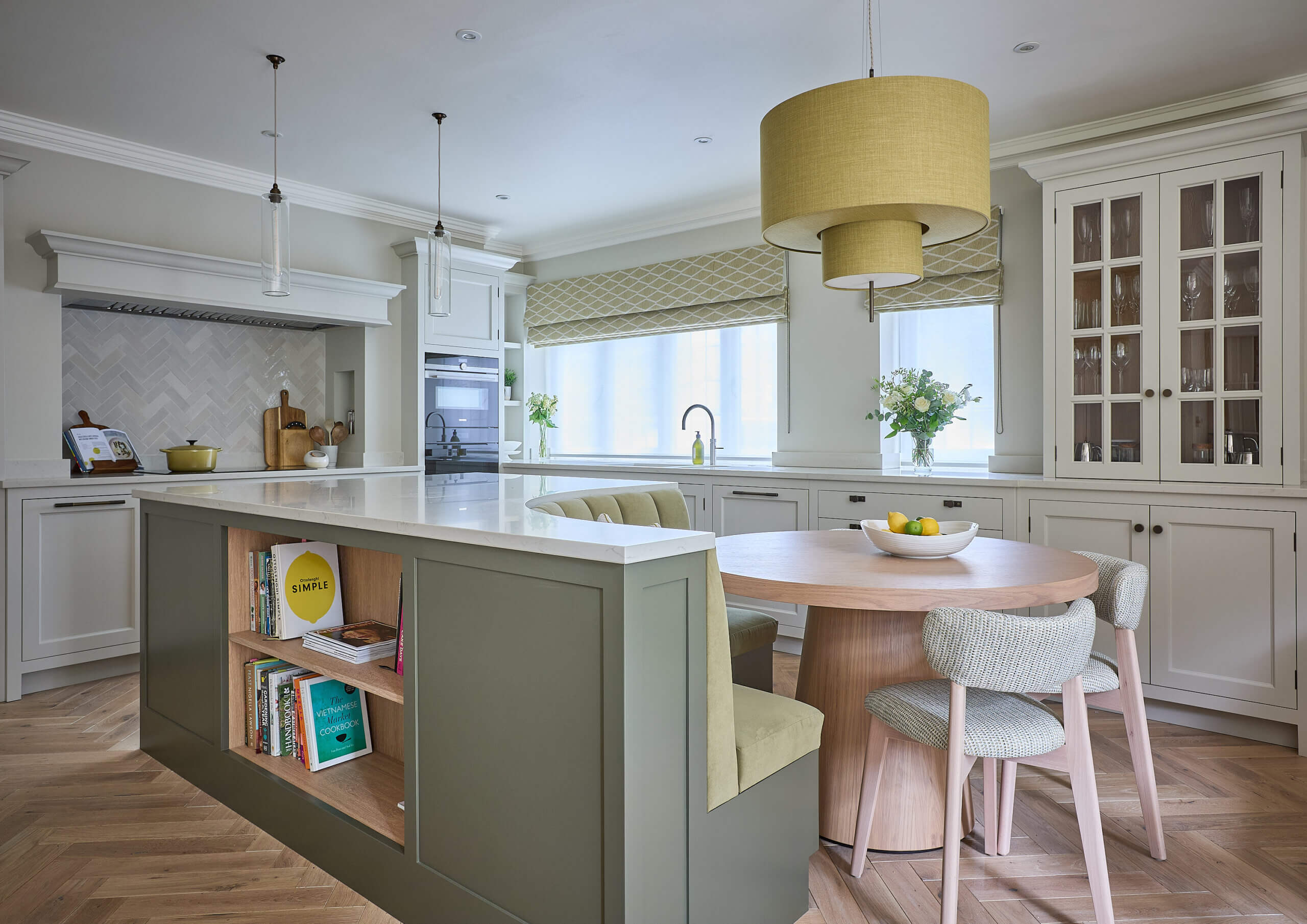
The main brief was to use the space better, both from an aesthetic and practical point of view. The previous kitchen lacked a visual focal point and the U-shaped layout meant there was a large (and not practical) gap between the back run and the peninsula space, which was where a lot of the prep work was done (as the back run was taken over by various small appliances). The tall units were along the left-hand wall when you walked in and felt overbearing, with the fridge being a long way from any worktop.
It was also very important for the client to incorporate a seating area in the island. They have a beautiful large dining room opposite the kitchen, so they weren’t fussed about having a formal dining area but wanted a space for informal dining or working. They didn’t want to sit at bar stools however, and wanted to have a nice view out onto the new French doors.

Q) How did you answer that brief?
The project included a full renovation of the kitchen and utility. A faux chimney breast to hide the extractor with tall units either side and a beautiful herringbone tiled splashback were added to the back wall to create a visual focal point.
By making the faux chimney breast, we gave the back run a focal point and some symmetry, with the Shaker style in keeping with the traditional overall feel of the house and property. Directly behind the hob we have the island, which is the perfect prep space.


Q) And the pantry and banquette?
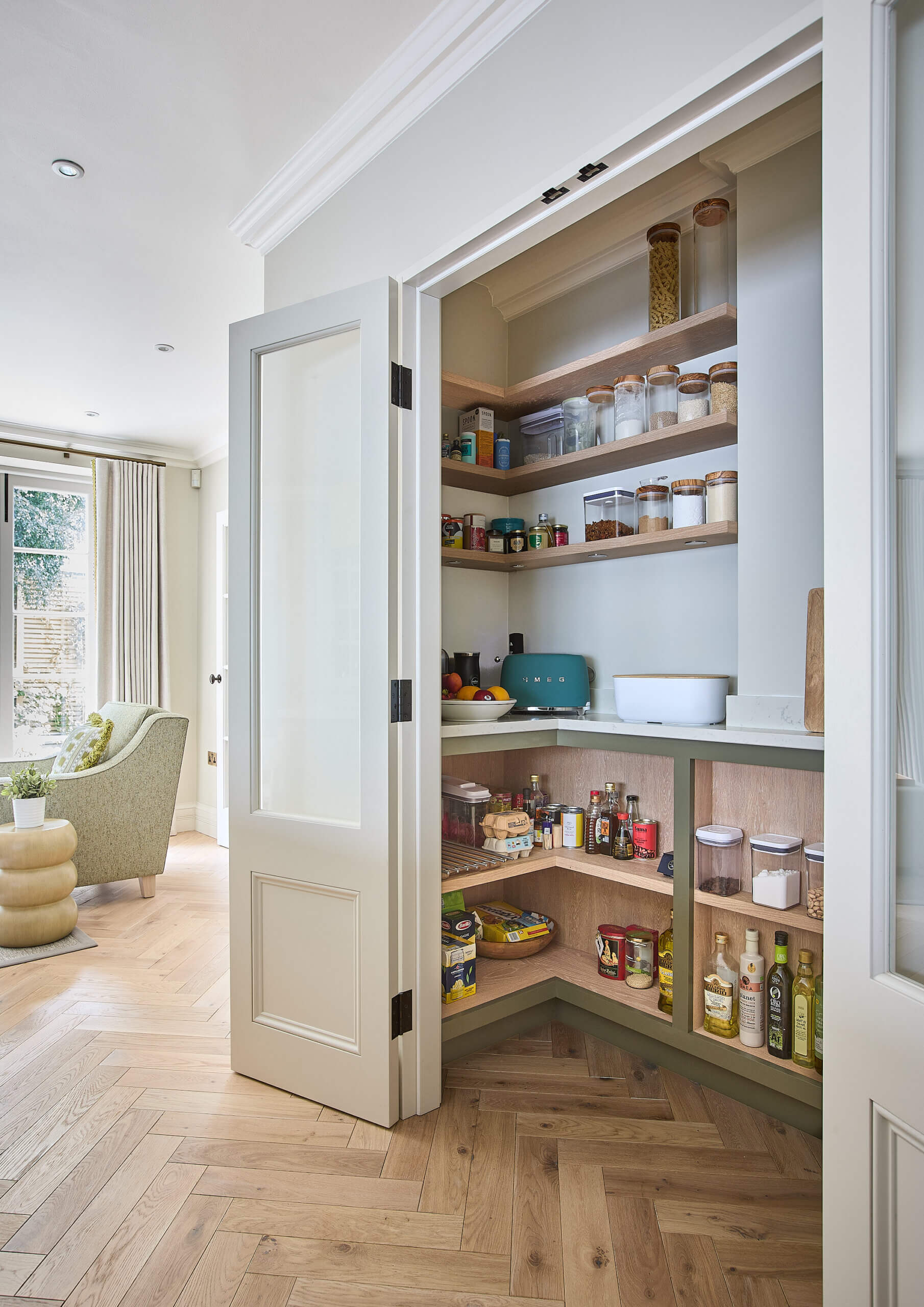
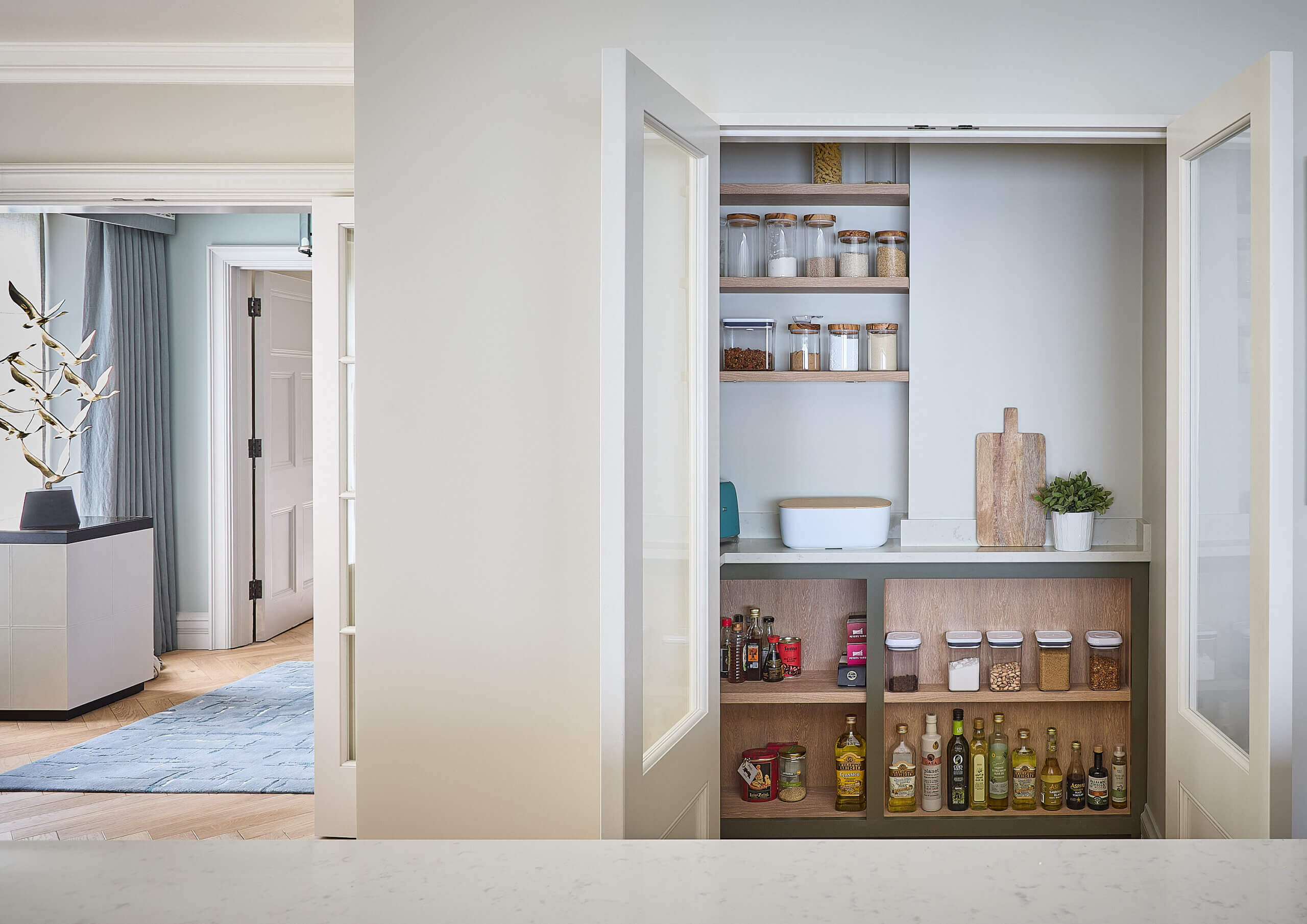
By creating the step-in pantry, this could keep all of the small appliances from cluttering the worktops, and also cleaned up the stepped-out walls.
To answer the client’s brief for informal island seating, a curved banquette was created to enjoy casual meals, morning teas or coffee and to make the most of the beautiful views of the garden.

Q) Tell us more about the cabinetry and paint colours
The kitchen was designed using Kitchens by Holloways’ Ludlow range with their Schuller collection in the utility. Cabinetry interiors are oak veneer stained in a light grey stain with solid oak drawer boxes and dovetail joints. Cutlery and utensil inserts are solid oak too. For the paint colours, we chose Farrow and Ball’s Shaded white and Olivine from Zoffany.

Q) Which design elements do you think make the scheme so successful?
The faux chimney breast definitely makes this scheme successful. It provides symmetry and also acts as a beautiful focal point. The island also makes this space come together as a whole.
Having previously had a big open peninsula layout with lots of wasted space, the island now provides valuable worksurface at arm’s reach in the right layout.
The curved banquette seating also makes the overall informal yet elegant feel complete. It’s the perfect space to relax and enjoy your surroundings.


Q) Any advice for anyone who may be planning their own kitchen project?
Before you undertake a kitchen renovation project, it’s important to understand terminologies. Terms such as ‘handmade’ and ‘bespoke’ are open to interpretation by kitchen companies.
They often relate to a specific kitchen style being available in custom sizes. ‘Handmade’ doesn’t necessarily mean high quality. The quality of a kitchen depends on the materials and mechanisms used, the skills of the cabinetmakers, the tools available, the working environment and quality control processes. It’s important to understand the parameters of what is being offered and the cost implications before embarking on a design process. A designer has the experience of past projects to understand and know what works and what doesn’t, both practically and aesthetically. Kitchens are extremely practical spaces, and creating that balance between style and functionality is something that a designer is able to offer.
It’s vital that the layout works for each homeowner and their needs, and a designer can offer a more objective view and even suggest completely different and new ideas that you may not have thought of.
Designers also have knowledge of appliances and bespoke solutions and they can look at the flow of a space properly and ensure that moving from one area to another will be seamless. A designer can listen to your needs, your habits and your requirements and make sure everything is catered for in the best way for your home.

The details:
Kitchen from Kitchens by Holloways
Worksurfaces by CRL Stone
Tiles by Fired Earth
Appliances by Fisher & Paykel, Siemens and Westin
Sink and tap by Franke and Quooker
Handles by Armac Martin
Paint by Farrow & Ball and Zoffany


Hayley loves: how fresh and inviting this space looks, thanks to the clever use of colour and thoughtful design.

Share this article
Featured Product: LEGRABOX
Win a Blum ORGA-LINE box worth £320!!!
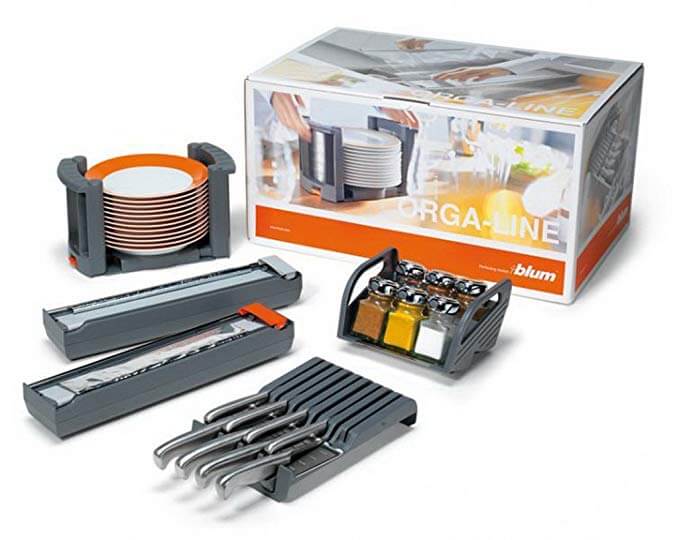
Every month The Kitchen Think is giving away one of these indispensable kitchen organisers worth £320!!




Leave a comment